
By Dr Hannah Moore, Founder, Be Moore Forensic Recruitment
CSI pay, qualifications and recruitment: what 154 UK forensic job adverts reveal
How much does a Crime Scene Investigator actually earn? Do you really need a forensic science degree? And why, when entry-level positions attract so many applicants, are police forces offering additional incentives to retain experienced practitioners?
Drawing on an archive of 154 UK forensic job advertisements collected by The Forensic Training Partnership between 2023 and 2026, I set out to explore what the data reveals about salaries, qualifications and the realities of recruitment across the profession. The adverts come from 50 employers, from individual police forces and regional collaborations to national agencies and private providers.

What does a CSI earn?
More than it used to. Across 43 adverts, qualified CSI basic pay averages £32,400 to £37,600. Across the adverts analysed, the average advertised CSI salary midpoint increased by approximately 14% between 2023 and 2026, from £32,000 to £36,300, although differences in the roles and employers represented each year should be considered.
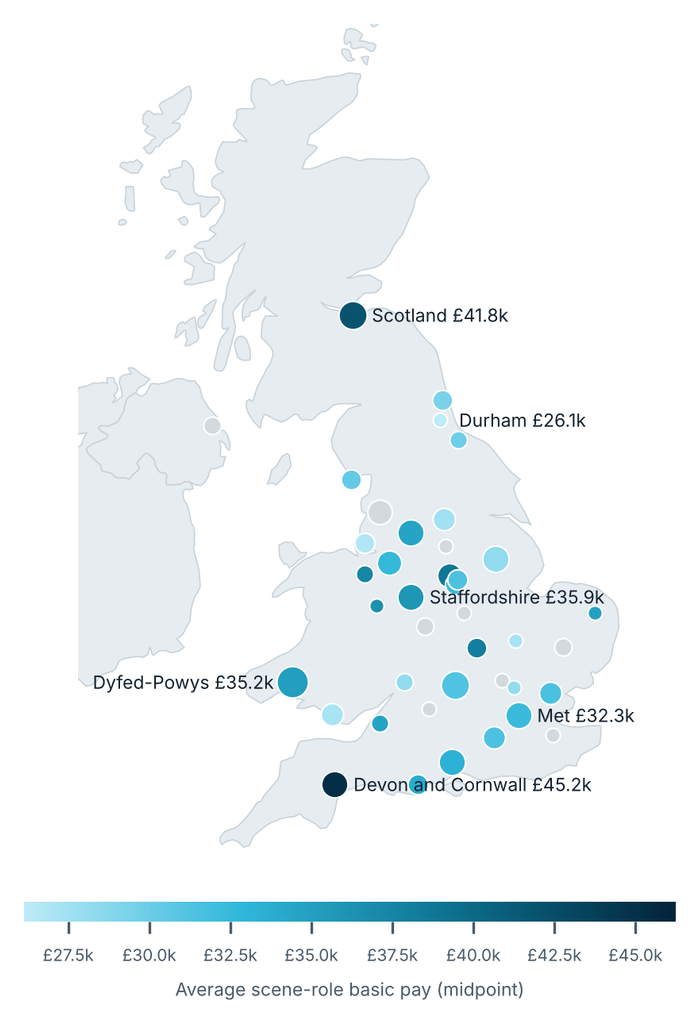
Where you work matters as much as when. Within South West Forensics alone, Avon and Somerset advertises CSIs at £33,600 to £35,800 while Devon and Cornwall offers £44,700 to £49,700: over £10,000 apart between advertised CSI roles.
Where the roles are
Each circle is an employing force: colour shows average scene-role pay, size shows number of adverts.
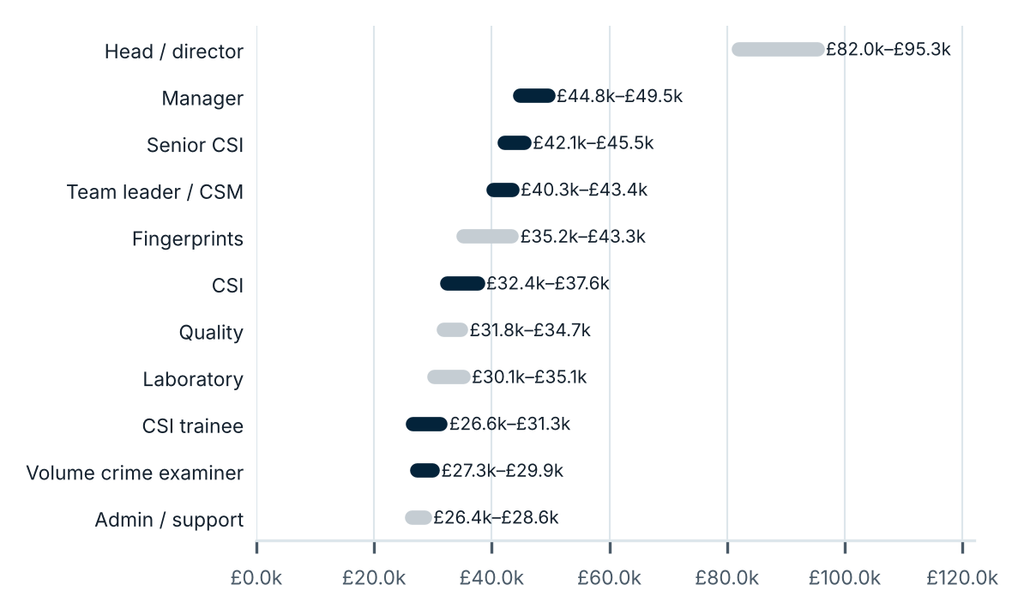
There is a clear career ladder too. Trainees start at around £26,600 to £31,300, Senior CSIs reach £42,100 to £45,500, and heads of forensic services £82,000 to £95,300.
Allowances change the picture further. Thames Valley’s October 2026 advert (closing 25 October) shows how they combine with progression: a Tier 1 CSI starts on £32,339 plus a 15% shift allowance, rising to £36,474 at Tier 2 with an 18% shift allowance, on-call payments and a 15.5% criticality allowance. Across the archive, scene-role shift allowances range from 10% to 22.5%, so the headline salary can understate the real package considerably.
CSI pay by advert year
Average midpoint of basic pay for CSI-level adverts; grey dots are individual adverts.

Career ladder
Average advertised range by level, all employers. Scene career path in navy.
Do you need a degree?
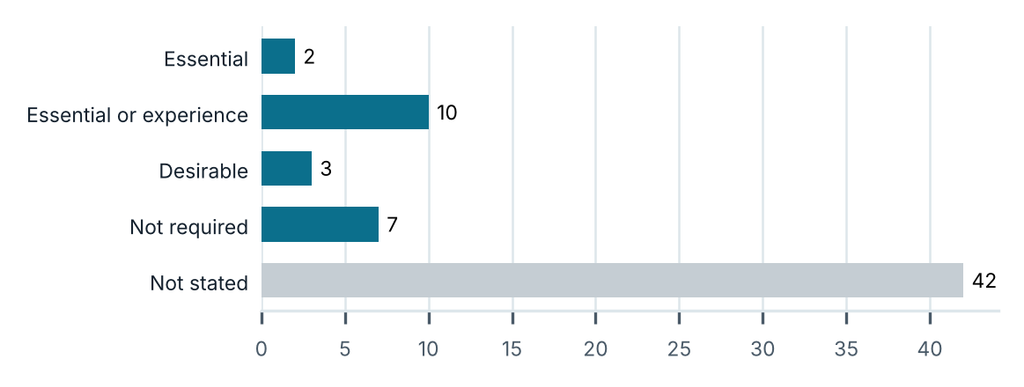
Perhaps fewer than you might expect. Most scene-role adverts (42 of 64) do not state a position at all. Of the 22 that explicitly addressed degree requirements, only two specified a degree as essential. Ten accepted equivalent experience, while seven stated that no degree was required. Several entry routes ask only for GCSEs in English, maths and science, or a science A level, alongside a full driving licence.
Why is getting into CSI so competitive?
Because demand far outstrips supply at the entry level. Gloucestershire and Northamptonshire warn that adverts may close early because of application volumes, and Thames Valley’s latest advert carries the same warning. South West Forensics, Yorkshire and Humber and Thames Valley all hold 12-month talent pools of appointable candidates, so passing the process does not guarantee a post. Selection typically runs from sift and assessment centre to interview and vetting, and can take six months. Being appointable is not enough; you have to stand out.
The recruitment paradox
At the other end of the market, the adverts tell a different story. Premiums sit on experienced posts: Thames Valley’s 15.5% criticality allowance for qualified CSIs, Staffordshire’s market supplement for Crime Scene Managers and the NCA’s £3,000 retention allowance. Thames Valley also invites already-trained CSIs to join at the level they are trained to.
The picture suggests a recruitment paradox: while entry-level vacancies can attract substantial interest, some forces are offering additional incentives to recruit and retain experienced practitioners. The challenge may be less about attracting applicants and more about finding people with the right operational experience.

Turning insight into opportunity
For aspiring CSIs, the findings offer both encouragement and a reality check. A degree is not always essential, and there are different routes into the profession. However, competition for entry-level positions can be considerable, making preparation and an understanding of the recruitment process particularly important.
This is where experienced practitioners have a valuable role to play. The Forensic Training Partnership’s two-day CSI Recruitment Preparation Course gives aspiring investigators the opportunity to experience a mock burglary scene at Cranfield University, receive individual feedback from former senior practitioners, and develop their approach to applications and interviews, including a Q&A with police forensic recruiters.
For employers, the findings highlight a different challenge: attracting and retaining experienced forensic practitioners. Having spent my career working within forensic science, I know how important it is to understand not only the technical requirements of a role, but also the operational realities behind it.
That understanding is what led me to establish Be Moore Forensic Recruitment, bringing a practitioner-led approach to specialist recruitment for police forensic units, laboratories and other forensic organisations.
Dr Hannah Moore is an operational forensic scientist and expert witness, and was Senior Lecturer and Forensic Programme Director at Cranfield University for a decade. She now leads Be Moore Forensic Recruitment, in partnership with VRS Recruitment.
Recruitment built for forensics. www.bemooreforensicrecruitment.co.uk | Recruitment for Scientists, by Scientists. www.vrsrecruitment.com
Figures are advertised basic pay, excluding allowances unless stated. Data: The Forensic Training Partnership archive of UK forensic job adverts, 2023 to 2026. For course dates, visit forensictraininguk.org.
To download a PDF version of this report please CLICK THIS LINK
Disclaimer
The Forensic Training Partnership (FTP) provides this document for general information only. Findings are based on the job advertisements analysed and should not be taken as a comprehensive or necessarily current representation of UK forensic employment. Advertised salaries, allowances, qualification requirements and recruitment arrangements vary by employer and may change. Readers should confirm details directly with the recruiting organisation. The analysis and views expressed are those of the author and do not necessarily reflect those of FTP. Participation in an FTP training course does not guarantee employment or success in a recruitment process
